Would You Pay to See Them Again? The Rise of the Hologram Afterlife
Would You Pay to See Them Again? The New Hologram Afterlife
As AI recreates the faces, voices, and presence of the dead, grief is entering a world where memory, technology, and the supernatural are becoming harder to separate.
What would you pay to see someone you love one more time?
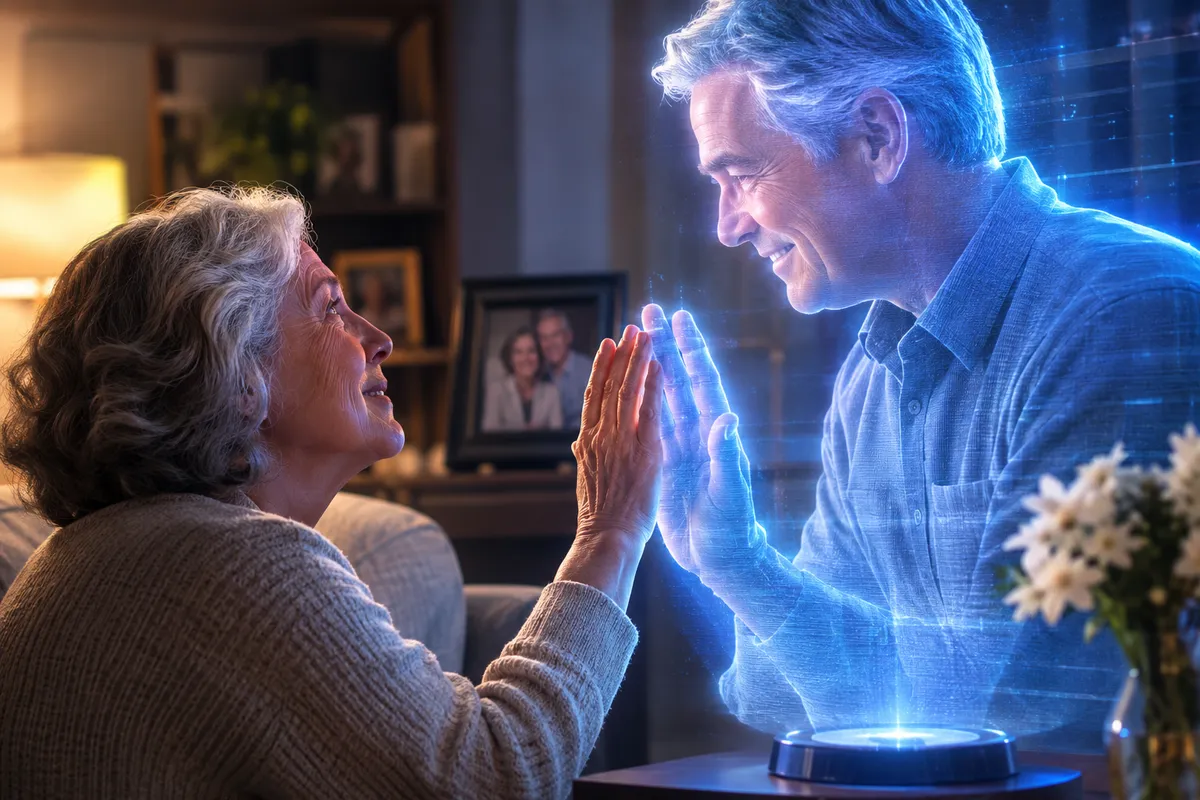
Not in a photograph. Not in an old home video or through a voicemail you have saved for years. Imagine instead that the person appears before you nearly life-size, moving in familiar ways, speaking in the voice you remember, perhaps even looking toward you as though the distance between life and death has temporarily collapsed.
Would you step closer? Would you speak to them? And if technology allowed you to experience that moment repeatedly, would you ever want it to end?
These questions are no longer confined to science fiction.
Artificial intelligence, voice replication, digital avatars, projection systems, and increasingly sophisticated holographic displays are beginning to reshape the way people think about death and remembrance. What was once primarily used for entertainment, celebrity performances, and technological demonstrations is moving into the deeply personal territory of memorials, funerals, legacy preservation, and grief.
In April 2026, Pam Cronrath drew international attention after creating a life-size digital representation of her late husband, Bill, for his memorial service. The couple had been married for nearly six decades. His digital image appeared before approximately 200 mourners, delivered a prepared message, and participated in a scripted question-and-answer presentation. Pam reportedly began with a budget of about $2,000 for what she called a “super wake,” but the project eventually cost many times that amount.
The money attracts attention. The psychology behind it should interest us even more.
To someone outside of grief, spending thousands of dollars on a digital recreation may seem excessive. But grief changes the value we place on things. A shirt left hanging in a closet can suddenly feel priceless. A ten-second voicemail can become something we protect for years. A photograph we barely noticed before the death can become one of our most treasured possessions.
Once someone dies, the question is no longer simply, “How much is this worth?”
It becomes, “How much is one more moment with them worth to me?”
Why Would Someone Want to Bring Them Back?
Behind the technology are three very human desires.
The first is one more goodbye.
Death leaves unfinished sentences. There are apologies that were never spoken, questions never asked, conflicts never repaired, and ordinary conversations that no one realized would become the last conversation. For someone carrying that kind of grief, the possibility of seeing a loved one appear again—even through technology—can be enormously powerful.
A digital recreation cannot actually change the past, and an AI-generated response is not the consciousness of the person who died. But emotionally, the experience may still function as ritual. Human beings have always created ceremonies to help us acknowledge endings that our hearts struggle to accept.
The second desire is legacy.
We do not only miss people when they die; we fear losing pieces of them. Their stories. Their expressions. Their humor. Their voice. The way they explained things. The history that existed only inside their memory.
For centuries, families preserved that legacy through portraits, handwritten letters, photographs, journals, recordings, and oral history. AI introduces another possibility: future generations may not simply look at an ancestor's photograph. They may someday hear that person's voice, watch their expressions, and interact with a digital representation built from material that person left behind.
That may feel extraordinary—and for many families, beautiful.
But there is a major difference between preserving something a person actually said and allowing artificial intelligence to generate something the person might have said.
That difference takes us into much more complicated territory.
The third desire may be the most important: I still feel connected to them.
Bereavement researchers describe what is known as a continuing bond—an ongoing inner relationship with someone who has died. People may talk to their deceased spouse, continue family traditions, wear a parent's jewelry, visit a grave, keep photographs nearby, or make decisions while imagining what the person would have advised.
Research shows that continuing bonds can involve both comfort and distress and are closely connected with identity, meaning, relationships, and spirituality. They are not automatically something that a grieving person must eliminate in order to heal.
But artificial intelligence changes something important.
A photograph does not answer.
A wedding ring does not generate a new sentence.
An AI representation potentially can.
And that may transform an internal relationship with memory into something that feels externally interactive.
When Technology Begins to Feel Supernatural
This is where the conversation becomes especially fascinating.
Throughout history and across cultures, grieving people have described sensing the presence of someone who died. Some report vivid dreams. Others describe hearing a familiar voice, noticing a scent, briefly seeing the person, or simply experiencing an intense sense that they are nearby.
Researchers sometimes refer to these experiences as sensory or quasi-sensory experiences of the deceased. An interdisciplinary review found that such experiences are frequently reported in bereavement and that the vast majority described in the literature should not automatically be treated as pathological. Their meaning often depends on the person's relationship, beliefs, culture, and life story.
Science can study these experiences. It cannot determine every spiritual meaning that a person attaches to them.
Now imagine placing sophisticated technology inside that already emotional space.
A widow knows her husband has died. Then his image appears before her.
Her rational mind understands that technology created the experience. But her eyes recognize his face. Her ears recognize his voice. Her emotional memory recognizes the person she loved.
That is what makes holographic memorialization different from simply watching a video.
It creates the illusion of presence.
And that leads to a question that may become more important as these systems improve:
What happens when technology begins reproducing experiences human beings once associated almost entirely with dreams, visions, spirits, and the supernatural?
The hologram does not have to contain a spirit for the experience to feel spiritual.
That distinction matters.
Some families may describe such an experience as an extraordinary memorial. Others may feel it crosses a religious or spiritual boundary. Cultural traditions will also shape these responses. There is no responsible basis for assuming that every African American, Latino, Caribbean, Christian, secular, or multigenerational family will interpret this technology the same way.
What one family calls a beautiful final tribute, another may consider something that should never be done.
Both reactions deserve respect.
The Ghost in the Machine
There is an even more difficult question.
Suppose a person recorded a message before dying and that exact recording is later projected holographically. Those are still the person's words.
But what happens when AI begins generating new responses?
If the digital version of a deceased mother says, “I forgive you,” who actually granted the forgiveness?
If a deceased husband appears to say, “I want you to remarry,” who made that decision?
If an AI father tells his adult child, “I'm proud of you,” is that preserved memory—or generated reassurance?
The face may belong to the deceased. The voice may resemble the deceased. The language may be based on years of messages, recordings, and photographs.
But resemblance is not consciousness.
Researchers examining AI grief bots are already raising concerns about consent, emotional dependency, manipulation, and the commercial relationships that may develop between grieving users and digital recreations of the dead. A 2026 paper in the Journal of Responsible Technology specifically argues for safeguards involving consent and protection against unhealthy dependency.
This may eventually become one of the most uncomfortable issues in the entire DeathTech industry because grief does not behave like an ordinary consumer market.
Imagine receiving a notice that your subscription has expired and access to the digital version of your husband has been suspended.
Imagine a company shutting down and thousands of families suddenly losing access to digital recreations they have interacted with for years.
Imagine grieving someone physically—and then someday grieving their digital version as well.
Technology is giving us extraordinary power to preserve memory. But emotional vulnerability cannot become simply another business model.
So, What Would You Pay?
Perhaps the most important question is not whether holographic grief technology is good or bad.
The same technology could preserve a family's history, create a meaningful memorial, allow future generations to hear someone's story, or provide a symbolic goodbye.
For another person, the same technology could make accepting physical absence more difficult.
The difference may depend on the individual, the timing, the purpose, and how the technology is designed and used.
There is a profound difference between remembering someone and attempting to make their absence disappear.
Grief eventually asks us to hold two realities at the same time: someone can remain deeply present in our identity while being physically absent from our lives.
Holographic technology challenges that boundary because it can make absence look remarkably similar to presence.
Perhaps that is why the subject feels almost supernatural.
Human beings have spent thousands of years asking whether the dead could return, whether we might hear their voices again, and whether love somehow continues beyond physical death.
Technology can now reproduce a face. It can recreate a voice. It can imitate movement. Artificial intelligence can even generate new words.
But it leaves us with an ancient question that no machine can answer for us:
Is seeing someone the same as having them with us?
And perhaps one even more uncomfortable question:
If someone you deeply loved could appear before you again tonight—looking like them, moving like them, and speaking in the voice you remember—how much would you pay for one more moment?
And who should be allowed to sell that moment to you?
This article is for educational and informational purposes. AI-generated avatars, holographic memorials, and digital recreations are technological simulations and are not scientific evidence that the consciousness, soul, or spirit of a deceased person has returned or is communicating through technology.
Jeanette Bass-Trigo, MSW
No Grief Zone Academy
Peace Beyond the Pain